
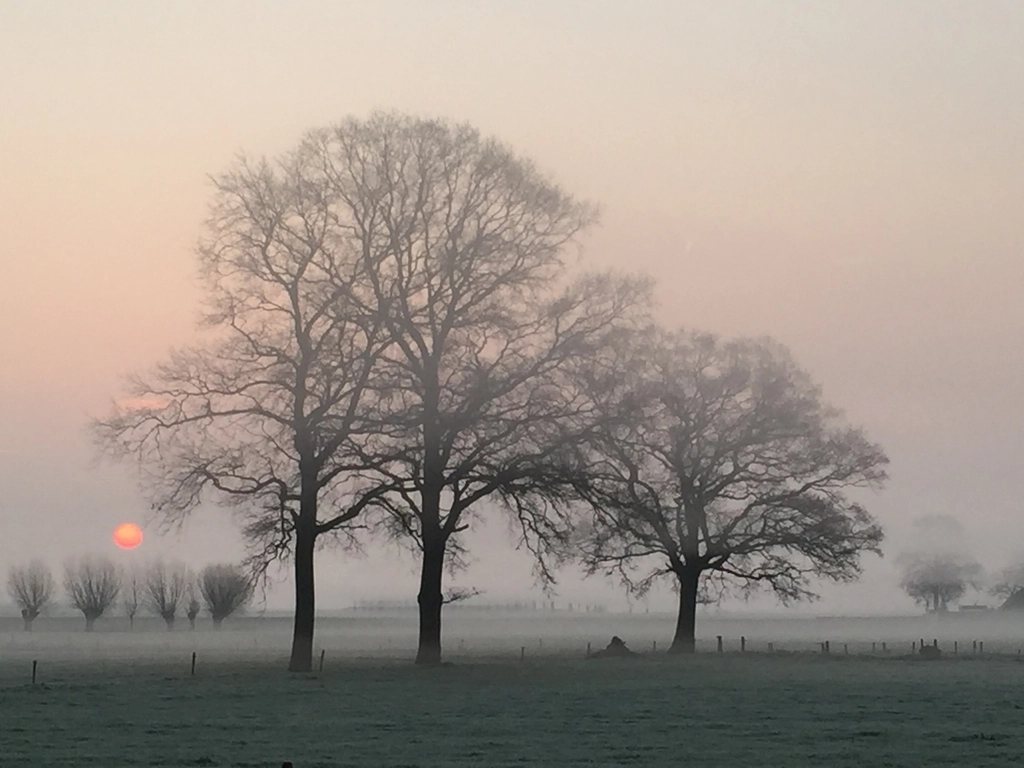
When is the best time to come to Somerset? There are two strong answers, neither of them summer. October and March are the months when the county belongs to itself again: the school holidays are over or not yet begun, the lanes are empty, the light is low and long, and the room that cost a fortune in August can be had for something closer to what it is worth. The price of that is weather you cannot bank on and days that end early. The trade is a good one, and this is what to expect.
What October is like
October in the West Country is a month of two halves. The first fortnight often carries the last of the summer’s warmth: daytime highs around 14 to 16 degrees Celsius, still evenings, and mornings when mist lies on the Levels so thickly that only the tower of a church shows above it. The second half turns. Atlantic fronts arrive more often, the wind gets up on the Mendip ridge, and by the last week the trees along the combes of Exmoor are properly turning, beech first, then oak.
Rain is the thing people fear, and it is fair to say that October is wetter than September almost everywhere in Britain. But it tends to come in bursts rather than as a week of drizzle. A typical October week here gives two or three wet days, two or three fine ones and a couple that cannot make up their mind. Plan a wet-weather day into every four, and you will rarely be caught.
The light in October
This is the month’s real gift. Sunrise moves from about ten past seven at the start of the month to nearly eight by the last week, and sunset from nearly seven to a little before five once the clocks go back on the last Sunday. That means the sun never climbs very high, and for much of the day it sits at the angle photographers call golden hour. Stone walls throw long shadows across pasture; the ridge-and-furrow of an old field shows up like corduroy; the Levels flare gold at four in the afternoon.
The corollary is that walking days are short. A ten-mile (16 km) circuit over the Quantocks that is a leisurely stroll in June needs an early start in late October, and a head torch in the rucksack is not paranoia. Aim to be off the high ground by four and in the pub by five, which is, frankly, no hardship.
What March is like
March is the mirror image, and a little rougher. It begins as winter and ends, some years, as spring. Early March can bring frost, sleet on Exmoor and a wind that finds the gap between your scarf and your collar; late March can bring a still, blue day of 15 degrees when the blackthorn is out along every hedge and the first lambs are in the fields below the Mendips. Average highs run from about 9 to 12 degrees across the month, but the range is wide.
It is also, on the whole, drier than October, and it dries out as it goes. The Levels, which may have been under water in January, start to drain. Footpaths that were bogs are still soft, but passable. The catkins are out, the rooks are building, and there is a sense that the whole county is holding its breath for April.
The light in March
The days lengthen fast, by about four minutes every day. At the start of the month the sun sets a little before six; by the end, after the clocks go forward on the last Sunday, it is after half past seven. The light is thinner and cooler than October’s, less honeyed, more silver, and it suits the coast best of all. A late March afternoon at low tide on the Bristol Channel, with the mud shining and the Welsh hills visible across the water, is one of the finest sights in the West.
What it costs
This is where the shoulder season earns its name. B&B prices in Somerset generally follow a simple curve: a high-season rate from roughly Easter to the end of September, with peaks over bank holidays and the school summer holidays, and a low-season rate for the rest of the year. October usually sits at the lower rate, or on the way down to it, from the second week; March sits at the lower rate until Easter, which can fall anywhere from late March to late April.
In general terms, expect a room to be a fifth to a third cheaper than in August, and expect far more choice. Places that ask for a three-night minimum in summer will often take a single night in October. Some owners close for a few weeks in the depths of winter, so late March is worth checking, but October is almost universally open. Trains and car hire are cheaper too, and the advance rail fares that vanish in summer are usually still available a fortnight out.
Planning a shoulder-season week
Book somewhere with a drying room or at least an honest boot porch, because it will be needed. Pack for three seasons and expect to wear all of them in one day. Put the long walks at the front of the week and keep the towns, the churches and the cider farms in reserve for the wet days, rather than the other way round, because a forecast four days out is a guess and a forecast the night before is nearly reliable.
And keep the afternoons free. In October that means being somewhere high at four o’clock to watch the light go; in March it means the coast, or a west-facing pub garden with a coat on. Neither month is easy, exactly, but both reward the traveller who is willing to arrive when the crowds have gone and the weather has not quite decided. Come then, and you will see the county the way the people who live in it do.