
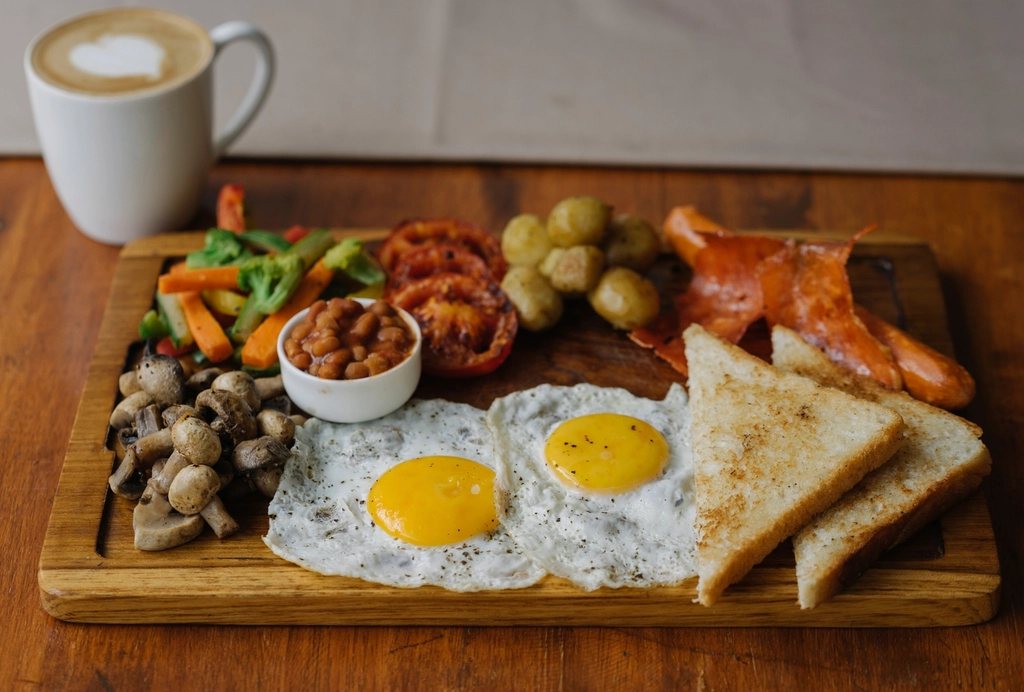
The cooked breakfast is the one meal a bed and breakfast is actually obliged to provide, and it is the meal by which guests, fairly or not, judge the whole stay. The full English is best thought of as a small piece of architecture. Each item on the plate has a job, most of them have a history, and a host who understands the reasons tends to cook a better version than one who is simply following a list. Here is the plate, item by item, in roughly the order the cook attends to it.
Where the plate came from
The idea of a large, hot, savoury morning meal is a Victorian one. In the country houses of the nineteenth century, breakfast was laid out on a sideboard in silver dishes: kidneys, kedgeree, chops, eggs done several ways, cold game and ham, with guests helping themselves before a day’s riding or shooting. The version we know today is a twentieth-century simplification of that spread, adopted by boarding houses, railway hotels and works canteens between the wars, and by then it had settled into the bacon, eggs, sausage and tomato that most people now picture. The phrase full English is later still, and it exists mainly to distinguish the whole plate from the continental breakfast of bread and jam. In Scotland, Wales and Ireland the plate has its own local additions; in the West Country, as shown below, it has a few of its own.
The meat, and the order it matters
Bacon in Britain usually means back bacon, a cut that includes a round of loin and a strip of belly fat, so it is meatier and less crisp than the streaky rashers of North America. A good host buys it from a butcher, dry-cured, and grills it rather than frying it, which keeps it tender. The sausage is where regional character shows: a coarse, herby pork sausage is the West Country norm, and a B&B that names its butcher on the menu is usually proud of it for a reason. Black pudding, a slice of blood sausage thickened with oats or barley and studded with fat, is optional on most menus and often left off by nervous guests; it is rich, peppery and, fried until the edges crisp, one of the best things on the plate. In Devon and Cornwall, and occasionally over the border in Somerset, you may be offered hog’s pudding instead: a pale, spiced pork sausage that is a local relative.
The egg is the guest’s decision
Everything else on the plate is the cook’s business, but the egg is yours. Fried is the default and should have a runny yolk and a set white; poached is the house speciality of any kitchen that has a good supply of fresh eggs, because a fresh egg holds together in the water and a stale one does not; scrambled should be soft and barely set, not the dry yellow rubble of hotel buffets. If the B&B keeps hens, and a surprising number do, the eggs will have deep orange yolks and the poached option is the one to take. It is quite acceptable to ask for two eggs or none. It is not acceptable, in a small house, to change your mind after the pan is on.
The vegetables are there for balance
The grilled tomato and the mushrooms are not garnish. They are there to provide acid and moisture against a plate of salt and fat, and a plate without them is heavier and less pleasant than it looks. Baked beans arrived on the breakfast table in the early twentieth century, when tinned beans became cheap, and they remain the most divisive element; ask for them on the side if you are unsure. Hash browns are a much later import, from the 1980s onwards, and a host who serves fried bread instead, a slice fried crisp in the bacon fat, is keeping an older tradition. Toast, in a rack so that it cools and stays crisp rather than steaming in a pile, with butter and a jar of marmalade, is the final structural element. The pot of tea, strong and served with milk, is not optional in any meaningful sense.
The West Country version
What sets a Somerset breakfast apart is less a different plate than a different larder. Local pork for the bacon and sausages, eggs from down the lane, mushrooms from a grower in the Levels, and a small wedge of farmhouse cheddar offered with the toast are all common. Some houses put a jug of local apple juice on the table beside the orange, and a few offer a slice of apple cake or a scone with the coffee afterwards. On the coast you may find a kipper or a piece of smoked haddock with a poached egg as the alternative to the full plate, and in the hills the porridge tends to be taken seriously. The best hosts will tell you, without being asked, where each thing came from. That is the difference between a breakfast that is included and a breakfast that is remembered.
The etiquette of a small dining room
A B&B kitchen is one person, sometimes two, and the rules exist to make that work. Most houses serve breakfast within a window of around an hour and a half in the morning, and many ask you to choose your cooked option, and your time, the evening before. Do it; a host who knows there are three full plates and one poached egg at half past eight can have everything hot at once. Mention allergies and dislikes when you book, not at the table. Lighter options, such as fruit, yoghurt, cereal and toast, are nearly always available and there is no shame in taking them on the third morning. And if you are walking that day, eat the full plate: on the Mendips or on Exmoor, ten miles (16 km) of wet hill are a great deal easier on a proper breakfast, and the kitchen will be glad you did.