
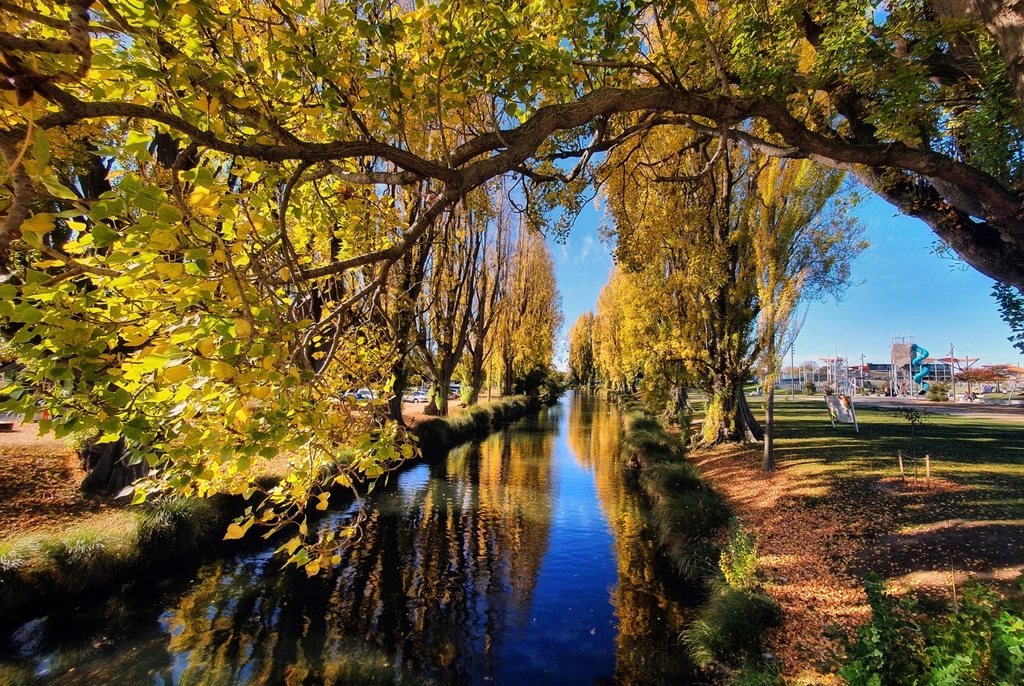
There is nowhere in Britain quite like the Levels for a bicycle. The land between the Mendips and the Quantocks is an old sea bed drained into fields, most of it at or barely above sea level, and the lanes that cross it are straight, quiet and almost perfectly flat. The only hills are the odd islands that once stood above the marsh, and even those are small. What replaces gradient is space: a sky that takes up most of the view, ditches gleaming in a grid to the horizon, lines of pollarded willows, and in winter, at dusk, one of the great wildlife spectacles of the country. It rewards a bicycle, and this is how to ride it.
Reading the landscape from the saddle
The first thing to learn is the word rhyne, pronounced reen. It means the water-filled ditches that divide every field, and they matter to a cyclist because the lanes follow them, the bridges over them are few, and a wrong turn can mean a two-mile detour to get across a channel you can see over. The bigger drains, like the King’s Sedgemoor Drain and the straightened rivers, have raised banks with tracks along them that are often better riding than the roads. The islands, Glastonbury Tor most famously but also the small round hump of Burrow Mump and the ridge of the Polden Hills, are where the villages sit, and where the views are.
The other thing to understand is that this is a working, managed landscape. The pumping stations, sluices and embankments are what keep it dry, and in a wet winter they do not always win. Lanes flood, sometimes for weeks. Before any winter ride, check which roads are under water, and carry the sort of lights that suit a landscape with no street lighting whatsoever.
A loop through the Avalon Marshes
A good ride starts and finishes in Glastonbury and covers around 25 miles (40 km) in a relaxed day. West of the town the road runs out along the old peat moors to Meare, once an island with a lake, where a stone fish house from the fourteenth century still stands alone in a field. From there a lane leads to the reserves at Ham Wall and Shapwick Heath, which face each other across a road and are joined by the trackbed of a railway that closed sixty years ago. The old line is now a traffic-free path, arrow-straight and lined with reeds, and cycling it in the early morning with herons lifting from the water is as good as the Levels get.
The route can be extended north over the Polden ridge, which is the one place you will need a low gear, and back through the villages of Ashcott and Street, or south across the moors to the River Parrett and the little town of Langport, which is about 15 miles (24 km) from Glastonbury by the quiet way. Muchelney, just beyond Langport, has the ruins of a medieval abbey and a famous willow-growing tradition, and was cut off entirely by floodwater for weeks in the winter of 2013 to 2014, which tells you all you need to know about the season.
Willows, withies and the craft that shaped the place
The willow you see everywhere is not decoration. The Levels have grown willow for basketwork for centuries, and around Stoke St Gregory and the moors to the east of the Parrett you will still pass fields of withy beds, cut each winter, and yards where the rods are boiled, stripped and stacked to dry. It is one of the few crafts in England still done more or less as it always was, and a couple of the growers welcome visitors in season. Riding past a withy bed in early spring, when the cut stumps sprout thin red and green whips, is one of the small pleasures of the year.
The starlings, and how to see them
From about November until February, and sometimes into March, several hundred thousand starlings, in a good winter closer to a million, roost each night in the reedbeds of the Avalon Marshes. Before they settle they gather in the sky and swirl in great shifting shapes for anything from a few minutes to half an hour. It is called a murmuration, and no photograph prepares you for the sound of it passing overhead. The roost moves between Ham Wall and Shapwick Heath from week to week, and the reserves post an update saying where the birds went the night before, so the sensible approach is to check on the day and then cycle to the right spot.
- Arrive at least an hour before sunset; in December that means being in place by three in the afternoon.
- Dress for standing still in a cold wind coming off open water, not for cycling.
- The car park fills early on winter weekends, which is precisely why a bike is the best way to arrive.
- Carry proper lights and reflective kit for the ride back; the lanes are unlit and the fog comes up fast.
The birds leave at dawn as well, all at once, in a noise like surf, and far fewer people see that. A B&B in Glastonbury, Meare or Ashcott puts you close enough to do both in a day if you are keen.
Bikes, wind and the practicalities
Any bike will do; the land does not care what is ridden. What it does care about is wind. With nothing to stop it between here and the Bristol Channel, a westerly can turn a flat ride into a slow one, so it pays to plan loops with the wind behind on the way home. Bike hire is available in Glastonbury and Wells, and the national cycle network route that crosses the county passes through both towns before running out over the moors, which is a useful spine if you are new to the area.
Surfaces are a mix of quiet tarmac, gravel droves and the odd farm track, and puncture kits are worth carrying because of the hedge cuttings. Food is thin on the ground away from the towns, so a packed lunch from your host is a sensible habit. And allow time. The whole appeal of riding here is that you can stop anywhere, lean the bike against a gate and look at a great deal of sky for a while without a car going past.