
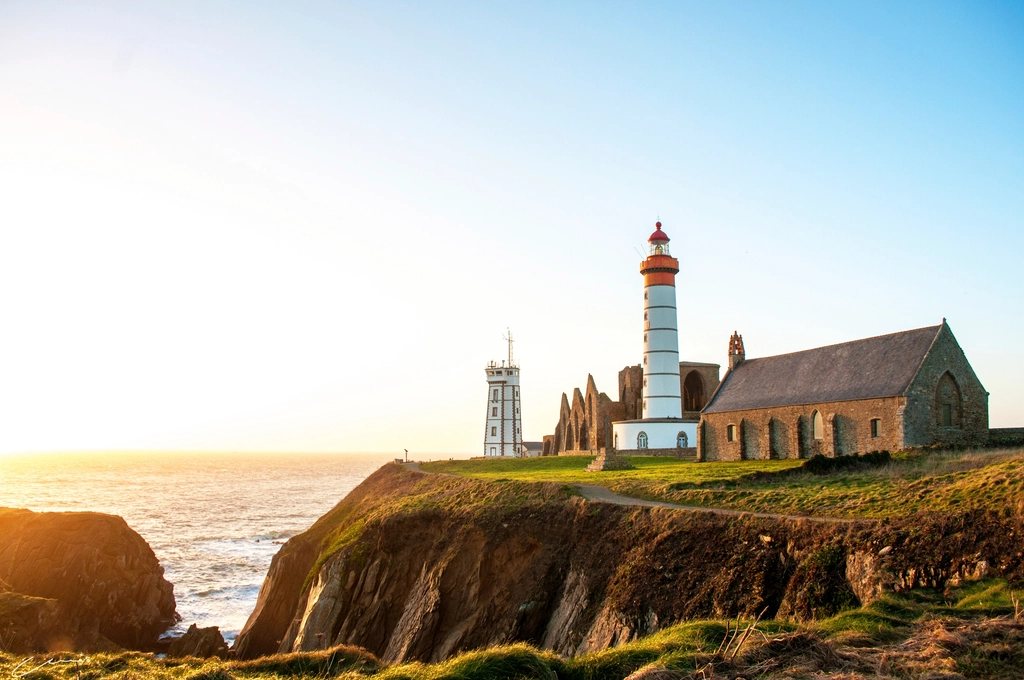
There are no keepers any more. The last of the lights on the Bristol Channel coast were automated in the 1990s, and the men who once climbed the stairs every evening are gone, along with their brass, their logbooks and their rota. What they left behind are the cottages: squat, whitewashed, built to take a gale, and now let by the night or the week to anyone who wants to sleep at the end of the land. A night in one is unlike an ordinary holiday let. Here is what to expect, and what listings rarely mention.
The coast the lights were built for
The Bristol Channel has one of the largest tidal ranges in the world, over twelve metres (40 ft) on a big spring tide, and a shipping lane that once carried coal, timber and passengers between South Wales and the West Country ports. That combination of fast water and busy traffic is why the lights came. Somerset’s stretch is low and sandy at the eastern end, with a wooden light on nine legs standing on the beach at Burnham since 1832 and a tall one behind it in the town, and it grows steeper as it runs west past the small red harbour light at Watchet, built in 1862. Then the land climbs into Exmoor and the coast becomes the highest in England: the cliffs at Great Hangman near Combe Martin reach 318 metres (1,043 ft). The headland lights along here, at the most northerly point of Devon and again further west, sit on ledges cut into those cliffs, with the cottages beside them and nothing else for a mile in any direction.
Getting there is the first half of the night
A keeper’s cottage was never meant to be convenient. On the Exmoor coast the light at the northern tip of Devon is reached by a mile or so (about 2 km) of steep, single-track lane that leaves the coast road on the top of the hill and drops towards the sea with a drop on one side and no passing places to speak of. Further west a similar lane runs out from a village to a headland where the original tower of 1879 had to be rebuilt in the 1970s after the cliff beneath it began to fall away. In both cases you drive slowly, you arrive with everything you need because there is no shop and often no mobile signal, and you park where you are told and nowhere else. The drive is part of the experience. By the time the cottage comes into view below, white against the grey, the ordinary world is some way behind.
Inside: thick walls, small windows and the wind
The cottages were built in a row, one for each keeper and his family, and they follow a pattern. Walls two feet thick. Windows small and deep set, facing away from the worst of the weather. A living room with a stove, a kitchen that once held the range, and bedrooms upstairs under a low roof. Modern lettings have added a proper bathroom, a heating system and some furniture that is not a bench, but the bones are unchanged and the atmosphere with them. The wind is the thing visitors tend to underestimate. Even on a mild evening it moves around the building constantly, finding the chimney, the letterbox, the gap under the door, and on a rough night it is a physical presence, leaning on the walls. The keepers lived with it for decades. One night of it is exhilarating.
The light, the dark and what to do about the curtains
The beam still turns. At the light on the northern tip of Devon it shows four white flashes every fifteen seconds, and from the bedroom window you see not the lamp itself, which is above and behind you, but its sweep across the water and, on a misty night, its sweep across the mist. It is the most beautiful thing about the stay and the one that most affects your sleep. Some guests love it; some hang a blanket over the rail. Light sleepers should take the room that faces inland; everyone else should take the room that faces the sea. Where a fog signal survives, ask whether it is still in use; most on this coast were silenced years ago, but the memory of a horn every thirty seconds all night is enough to make the question worth asking. Then step outside at midnight, away from the cottage, and look up. There is no town for miles, and the sky does what it did for the keepers.
Morning on the ledge
Dawn at a lighthouse is the reason to go. Sitting on the wall above the drop with a mug of tea before six, a visitor can watch the channel turn from lead to pewter to silver as the sun comes up behind the Somerset hills to the east, while the Welsh coast, twenty miles (32 km) across the water, emerges from nothing. Fishing boats work the tide line below, and seals and gannets may be seen along this coast. The coast path runs directly past the gate and leads west along the cliff tops, with the tower always somewhere behind as a mark.
The practical side, honestly
These cottages are let through a conservation body or a specialist letting agent, generally for a minimum of three or four nights and often by the week in summer. They book up months ahead for the warm months and are far easier to get, and far more dramatic, from October to March. Prices sit above an ordinary cottage of the same size, and the difference buys the location, not the fittings. Bring food for every meal, a torch, warm clothes whatever the season, and a willingness to be cut off. Check whether the lane is passable in a normal car and in ice. Expect no wifi to speak of and treat it as a gift. And when you leave, close the gate on the headland behind you as the keepers did, and drive up the hill slowly, looking back.