
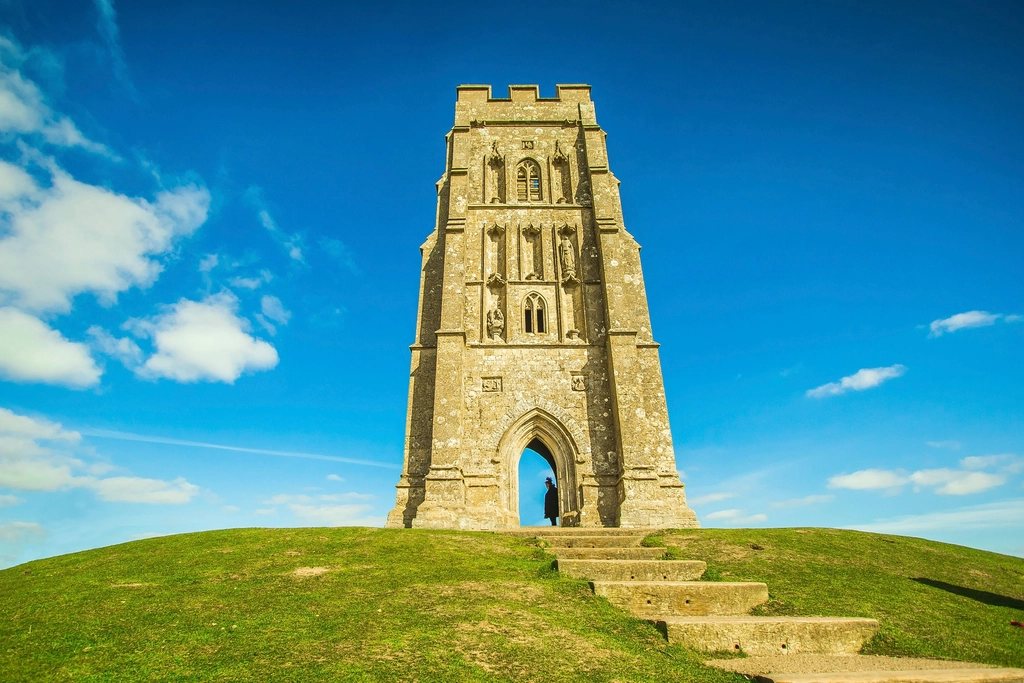
Most people see Glastonbury Tor, Cheddar Gorge and Wells Cathedral in a single day from a car park, and most people remember them as a blur. The three lie within about eight miles (13 km) of each other on the southern edge of the Mendips, and they are so different from one another, a hill that is almost a myth, a cleft in the limestone, and the most complete medieval cathedral close in England, that they deserve to be taken one at a time. They deserve three days, with a single base throughout and bus, foot and, if the legs allow, bicycle between them. This is a workable plan.
Choosing a base
Wells is the natural centre, not only because it sits between the other two but because it is where the buses meet. Glastonbury is fifteen minutes away by a bus that runs several times an hour; Cheddar is about twenty-five minutes in the other direction, with services roughly hourly through the day. Wells is also small enough to walk across in ten minutes, has a good weekly market and enough places to eat that three evenings do not repeat themselves. Glastonbury makes a livelier and stranger base, with more rooms at lower prices; Cheddar has plenty of beds but empties at dusk when the coaches leave. Whichever you choose, book ahead for weekends between Easter and October.
Day one: Wells, taken slowly
Begin in Wells. The cathedral west front is best in the morning light, its three hundred or so medieval statues still in their niches, and inside the great scissor arches added in the fourteenth century to stop the tower falling down are unlike anything else in the country. Look for the astronomical clock, which has been striking the quarters since the 1390s, and the worn stone stairs that curve up to the chapter house. Entry is by suggested donation rather than a fixed ticket, which catches people out.
Behind the cathedral a gate leads into a street of small stone houses built for the choir in the fourteenth century and still lived in by singers today; it is often called the oldest continuously inhabited street in Europe. Next door the bishop’s palace has a moat, a drawbridge and swans that were once taught to ring a bell for food. In the afternoon, walk out of the city westwards, past the paper-mill village of Wookey Hole, and up into the wooded cleft of Ebbor Gorge, a nature reserve where a short, steep loop of about two miles (3 km) climbs to a rock ledge with the whole of the Levels laid out below. Back for tea, with the towers in view most of the way.
Day two: Glastonbury and the Tor
The Tor is only 158 m (518 ft) high, but it rises alone from the flat land and looks far bigger than it is. The roofless tower on top is all that remains of a fourteenth-century church, and the terraces on its sides are still argued over: field strips, a processional path, or simply the marks of a thousand years of cattle. It is best climbed at the start of the day, from the town side, which takes half an hour at a stroll; going early matters because by mid-morning in summer the summit is crowded and the wind up there is famous. On a clear morning you can see the towers of Wells, the whole sweep of the Mendips and, to the west, the sea.
Down in the town the abbey ruins are the other half of the story: once among the richest monasteries in England, dissolved in 1539, now a green enclosure of broken arches that is far more peaceful than the high street outside, which sells crystals and cloaks to a visiting population of pilgrims and the curious. The gardens around the ancient spring below the Tor are the quiet place to end the day, and if the bus timetable allows, walking back to Wells across the fields is an alternative, about seven miles (11 km) on flat lanes with the cathedral growing slowly ahead.
Day three: Cheddar Gorge from the top
Cheddar is the one that needs the most care, because the gorge floor has been a tourist attraction for two centuries and it shows. The best approach is to arrive by the first bus, walk straight through the village and up the road into the gorge before the traffic, then take the steps that climb the southern side, all 274 of them, to the cliff top. From there a circular path of about four miles (6.5 km) follows the rim of the gorge on both sides, with the cliffs, which reach almost 450 ft (137 m), dropping away beside you and the whole of the Levels shining beyond. Wild goats graze the ledges. It takes three hours if you dawdle.
Only afterwards is it worth going underground. The show caves are commercial, with an admission charge that is not small, but the largest of them is genuinely remarkable, and it is the cave where, in 1903, the oldest complete human skeleton found in Britain was unearthed, a man who lived here around ten thousand years ago. The cheese that takes its name from the village has been matured in the caves for centuries, and one dairy in the gorge still makes it by hand and lets you watch. A wedge of that, and a loaf from the village, makes the bus ride back to Wells a picnic.
Small things that make the three days work
- Buy a day or multi-day bus ticket rather than singles; the Wells routes are all run as one network and the saving is real.
- Check cathedral service times; the building closes to sightseers during services, and evensong on a weekday afternoon is free and worth planning around.
- Carry a windproof layer even in July for the Tor and the gorge rim.
- Wear boots for the gorge cliffs; the path is rocky and the drops are unfenced in places.
Three days is not long. But spending a whole morning on a single hill, and a whole afternoon in a single building, changes what stays in the memory. The blur becomes three places, each with its own weather and its own silence, and a small city in the middle that feels familiar by the third morning.