
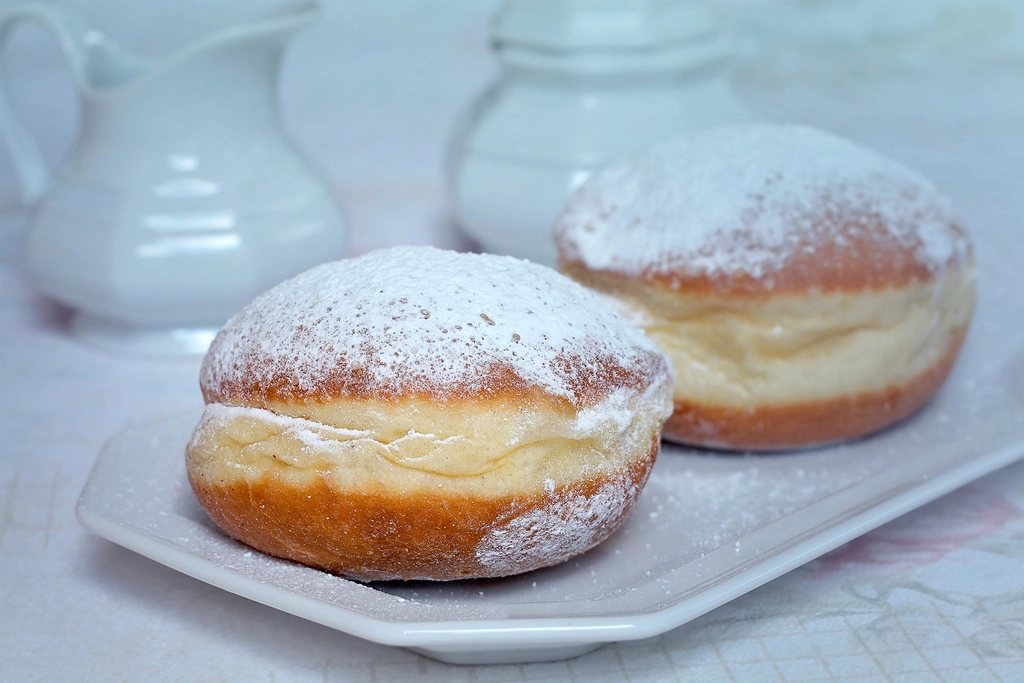
Bath has given the world two buns, and most visitors leave the city unsure which one they ate. It is not their fault. The two are sold within a few streets of each other, both are yeasted, both are golden, and both come wrapped in stories that are older than the evidence for them. The difference is real and worth knowing. One is small, dense and sugary. The other is large, light and nearly savoury. From there the story widens out to the whole of the West Country, which has a longer list of sweet breads than most people realise.
The Bath bun: sugar on top, sugar inside
A proper Bath bun is a rich, rather heavy roll made from a sweet yeast dough enriched with butter and eggs, with a lump of sugar baked into the base and a scatter of crushed sugar over the top. Currants or sultanas are usual now; in the eighteenth century the topping was more often caraway comfits, sugared seeds, which gave the bun a faint aniseed note that has almost vanished. The bun belongs to Georgian Bath, when the city was full of visitors taking the waters and looking for something sweet to eat afterwards. The most repeated legend attaches it to a physician of the spa who is said to have invented the bun for his patients, found they were growing fat on it, and devised a plain dry biscuit instead. The biscuit still carries his name and is still made; the bun story is unproven, but it is a good one and the city is not going to give it up.
The Bath bun’s moment of fame came in 1851, when the refreshment rooms of the Great Exhibition in London sold well over 900,000 of them in a summer. That popularity produced a cheaper imitation, the London Bath bun, lighter and less rich, which is the version many bakeries outside the West Country still make. The real thing should be heavy in the hand, sticky on top, and eaten with a cup of tea and nothing else.
The Sally Lunn: a bun the size of a plate
The Sally Lunn could hardly be more different. It is a large, round, very light bun, made from a soft dough enriched with cream and eggs, closer to a French brioche than to anything English, and baked as a single loaf perhaps six inches (15 cm) across. It is served split horizontally, toasted, and spread with butter, and it is as good with a savoury topping, such as cheese or ham, as it is with cream and jam. The name is the subject of the city’s other favourite legend: a young Huguenot refugee who arrived in Bath in the late seventeenth century and baked the buns of her homeland for the Georgian trade. Her name may be a corruption of a French phrase, or of a French name, or simply invented; nobody knows. The bun’s name appears in print in the late eighteenth century, and a house on a narrow street near the abbey, one of the oldest buildings in the city, claims to be where it was first baked. Whatever the truth, a Sally Lunn eaten warm, with the butter running into the crumb, is one of the great plain pleasures of the West Country.
Beyond Bath: the wider family
The West Country’s sweet breads share a family resemblance: yeast rather than baking powder, a soft crumb, fat and sugar in the dough, and a habit of being served with butter or cream rather than eaten dry. Each county has its own.
- The Cornish saffron bun, and its larger cousin the saffron cake, coloured deep yellow with saffron and studded with currants; the spice reached Cornwall by sea trade centuries ago and stuck.
- The Devon split, a soft white yeasted bun, split and filled with clotted cream and jam, which is the older base for a cream tea than the scone.
- Lardy cake, from Wiltshire and Gloucestershire on Somerset’s eastern and northern borders: bread dough folded with lard, sugar and dried fruit and baked until the base is caramelised and the top is crisp.
- Hevva cake, a Cornish fruited slab named after the cry that went up when the pilchard shoals were sighted, made quickly for the boats coming in.
- Somerset and Dorset apple cake, not a bread at all but a moist, spiced cake made with local cooking apples and often served warm with clotted cream or a slice of cheddar.
Why yeast, and why so much sugar
The pattern makes sense once you look at the region’s history. Bristol was one of the great ports of the eighteenth century, and sugar, dried fruit and spices came through it in quantity; Bath, a day’s ride away, was the most fashionable town in England and full of people with time and money to spend on small luxuries. Wheat grew well on the Somerset lowlands, and the dairy country of the Levels and the Vale produced the butter, cream and eggs that turn a plain dough into a rich one. Yeast was in every kitchen because everyone brewed. Put those together and you have a cuisine that leans naturally towards enriched breads, and the Georgian taste for eating them with tea at four o’clock fixed the habit. Baking powder, which made the scone possible, only arrived in the nineteenth century, and in this part of the country it never quite displaced the older buns.
Where you will meet them on a slow stay
You do not need to go to Bath to eat a Bath bun, though it is the right place to eat a Sally Lunn. Market-town bakeries across Somerset make Bath buns on Saturdays, and a few B&B hosts bake them for the breakfast table or for a wet-afternoon tea. Saffron buns turn up at farmers’ markets near the Devon border, apple cake almost everywhere in autumn, and lardy cake in the bakeries of the Frome valley and towards Bradford-on-Avon. The rules for eating them are simple. Warm is better than cold, and a day old is better than two. Butter belongs on all of them except the Bath bun, which has enough going on already. And if you are offered a slice of apple cake with a wedge of cheddar and are unsure, say yes; it is an old West Country pairing, and it works.