
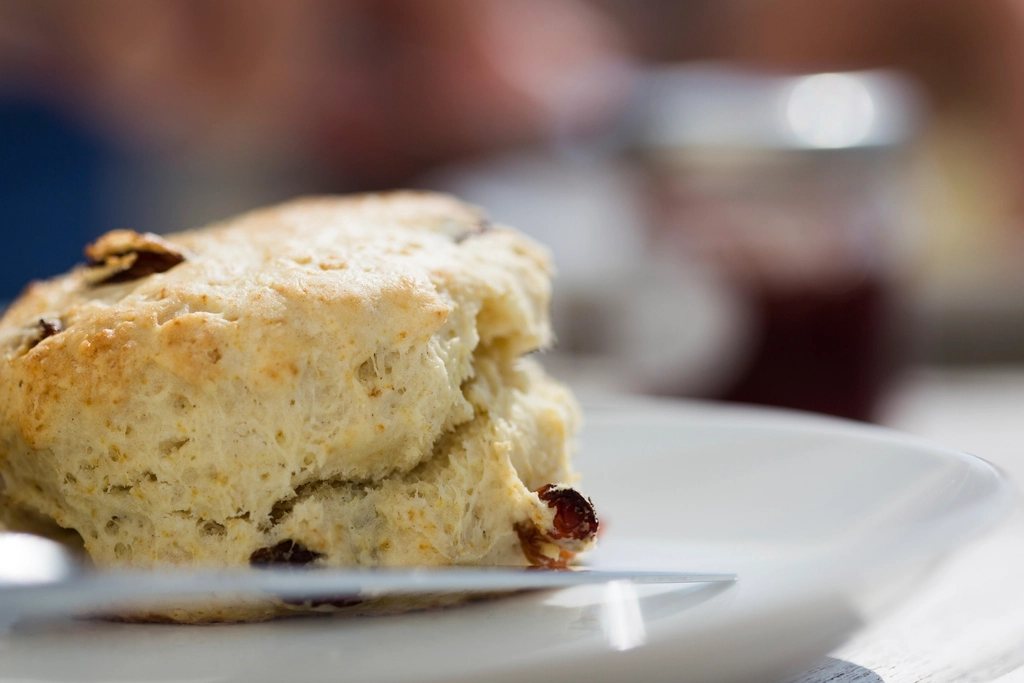
There is no quicker way to start a quarrel in the West Country than to spread a scone in front of a local. Devon says cream first. Cornwall says jam first. Both counties have flags, songs and strongly worded tea-room signs on the subject, and both will tell you that the other lot are doing it wrong. Somerset, which sits between them on the map and shares a border with each, has spent centuries politely declining to take sides. The Somerset position is the sensible one, but first, the argument.
What a cream tea is, and is not
A cream tea is a modest, specific thing: two scones, warm if you are lucky, a dish of clotted cream, a dish of jam, and a pot of tea. That is all. It is not an afternoon tea, which is a three-tiered production of sandwiches, cakes and pastries and costs several times as much. It is not a Devonshire tea, which is what the same meal is called in Australia and New Zealand, though it is the same meal. The scone should be plain or lightly fruited, split by hand rather than cut, and eaten in halves rather than as a sandwich. The jam is nearly always strawberry, occasionally raspberry, and the tea is a plain black tea taken with milk. A cream tea eaten at three o’clock is a small ceremony; eaten at five, after a long walk, it is supper.
Clotted cream, the ingredient that makes it
The cream is the point, and it is not the same as whipped or double cream. Clotted cream is made by heating rich milk or cream very gently, to around 80 C (176 F), for an hour or so, and then leaving it to cool slowly for the better part of a day. The fat rises and forms a thick, wrinkled, golden crust, which is skimmed off and packed. The result is around 60 per cent fat, well above the legal minimum of 55 per cent, with a cooked, nutty, faintly sweet flavour that no other cream has. Cornish clotted cream has had protected status since 1998, meaning it must be made in Cornwall from Cornish milk, but Devon and Somerset dairies make it by the same method and have done for as long as anyone can trace. A jar bought from a farm shop in the Levels will be just as good, and it keeps for a few days in a cool pantry.
Devon says cream first
The Devon method treats clotted cream as butter: spread it thickly on the scone, then spoon the jam on top. The argument is practical. The cream is firm enough to spread on a warm scone and the jam sits on it without sliding off, and it is the way you would build any buttered bun. Devon also lays claim to the whole tradition, on the strength of a story that the monks of an abbey at Tavistock, rebuilding after a raid in the late tenth century, fed their workmen bread, cream and jam. The evidence for the story is thin and it was only widely repeated in recent decades, but the county has adopted it wholeheartedly. Tea rooms across Dartmoor and the South Hams will serve you cream first without asking, and some will gently correct you if you reverse it.
Cornwall says jam first
Cornwall spreads the jam on the scone and puts the cream on top, in a generous dollop, like a crown. The argument here is about the cream: it is the finest thing on the plate, it should be seen and tasted last, and burying it under jam is a waste. There is also an older Cornish habit of eating cream with a split, a soft yeasted bun, rather than a scone, and of pairing the cream with treacle instead of jam, a combination known locally as thunder and lightning. Cornwall, having the protected name for its cream, tends to feel that it has the moral high ground in the debate, and Cornish tea rooms are if anything more insistent than Devon ones. Both counties are entirely serious, and both are entirely happy to sell you a second scone while you decide.
Where Somerset stands
Somerset has no rule, and this is best seen as a quiet strength rather than a lack of conviction. Tea rooms in the Mendips, in Wells and around the Quantocks put the cream and the jam on the table and let you get on with it. What the county contributes instead is the jam. The Cheddar Valley, on the south-facing slopes below the Mendips, was one of the great strawberry-growing districts of England from the nineteenth century until the 1960s, and the fruit went to the cities by rail on a branch line that became known as the Strawberry Line. The line closed to passengers in 1963, and its route now forms a walking and cycling path of about ten miles (16 km) between Yatton and Cheddar, which passes through the old strawberry ground and makes a fine morning before a cream tea. A few growers still sell Cheddar strawberries at the roadside in June, and a jam made from them is worth seeking out. Somerset also makes its own clotted cream, and a good local scone tends to be a shade richer than the Cornish kind, with a little more butter in the dough. A compromise that annoys everyone equally is cream first on a warm scone and jam first on a cold one.
Getting a good one on a slow stay
The scone is the weak link. A cream tea is only as good as a scone baked that morning, and a tea room that bakes in small batches through the day is worth a detour; ask when they came out of the oven, and if the answer is yesterday, have a slice of cake instead. Some B&Bs offer a cream tea on arrival, or on a wet afternoon, for a small charge or as a courtesy, and a host who keeps a jar of clotted cream and bakes her own scones is a host worth returning to. Prices in the countryside remain reasonable; in Bath and on the coast they climb. A bench with a view over the rhynes of the Levels makes the best setting, whichever way the scone is built. Cream first. Probably.