
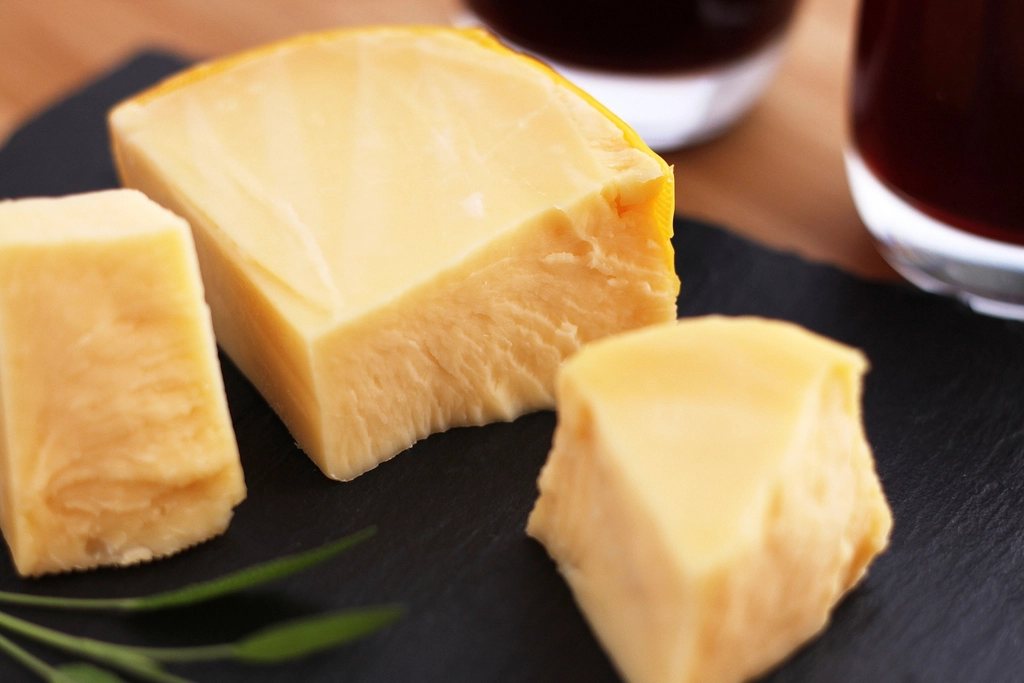
The word has travelled so far that it has almost stopped meaning anything. Cheddar is made in Wisconsin, in Canada, in Ireland and New Zealand, in blocks the size of a suitcase and in slices wrapped in plastic. Yet the village that gave the cheese its name is a real place at the foot of the Mendip Hills, with a gorge behind it, caves in the rock, and a handful of farms within a morning’s drive that still make the cheese the old way. What follows explains the difference between the cheese and the word.
A village that gave its name away
Cheddar sits where the gorge opens onto the flat land of the Levels. The gorge itself runs for nearly three miles (5 km), with limestone cliffs rising to around 450 feet (137 m), and it was the caves in those cliffs, cool and damp all year, that first made the place useful to cheesemakers. Records of cheese from Cheddar go back to the twelfth century; the royal accounts of 1170 note a large purchase for the king’s table. By the seventeenth and eighteenth centuries the cheese was being made across the Mendips and the Vale, sold at Wells and Bristol, and shipped a long way beyond. In the 1800s a Somerset dairyman wrote down and taught a consistent method, and it was that method, rather than the village, which crossed the oceans. Cheddar became a recipe, and a recipe cannot be fenced in.
What happens in the vat
The technique that makes cheddar cheddar has a name of its own: cheddaring. Warm milk is set with rennet and a starter culture, the curd is cut and the whey is drained, and then the curd is left to knit together on the floor of the vat. It is cut into slabs, and the slabs are stacked and turned, over and over, for an hour or more. The weight of the stack presses out more whey, and the acidity rises steadily as the curd rests. The slabs go from something like wet tofu to something like the breast of a cooked chicken, fibrous and springy. Then the curd is milled into pieces the size of a thumb, salted, packed into moulds and pressed overnight. It is slow, physical, repetitive work, and it is the reason the finished cheese has that firm, slightly crumbly bite instead of the rubbery smoothness of a factory block.
Cloth, lard and time
A traditional truckle, a tall cylinder weighing somewhere around 25 kg (55 lb), is not wrapped in wax or plastic. It is bandaged in muslin and sealed with lard, then left to breathe. The cloth lets moisture escape and allows a natural rind to form, and over months the cheese loses weight and gains depth. This is where the flavours that people describe as earthy, nutty or cellar-like come from; they are partly the work of the moulds that colonise the cloth. Vacuum-packed cheddar cannot do this, however long it is kept, because nothing is escaping. A cheese described as mature has usually had twelve months or more; extra mature or vintage may have had eighteen to twenty-four. The crunchy white crystals you sometimes meet in an old cheese are not salt but a natural by-product of long ageing, and they are a good sign.
Why a cave, and why it still matters
The caves at Cheddar keep a steady temperature of around 11 C (52 F) all year, with high humidity and no draught. That is close to ideal for maturing a cloth-bound cheese: cool enough that the rind develops slowly, damp enough that it does not crack. Before refrigeration this was simply the best storage available, and cheese from the surrounding farms was carted into the gorge to sit in the dark. Today a small number of truckles are again matured in the caves, and you can see them on shelves if you visit. The cave itself is only part of the story, though; a well-built stone cheese store on a farm does much the same job. What the cave gives is a reminder that cheddar is a cheese of place, of limestone and cool air, rather than a cheese of stainless steel and a barcode.
What “West Country Farmhouse” actually promises
Because the plain word cheddar is unprotected, a narrower name was registered in the 1990s under the European scheme of protected designations, and it still applies in the United Kingdom. To carry the name West Country Farmhouse Cheddar, a cheese must be made on a farm in Somerset, Dorset, Devon or Cornwall; the milk must come from that farm or from herds nearby; the curd must be cheddared by hand in the traditional way; and the cheese must be matured on the farm for at least nine months before it is sold. The rules do not require cloth binding or cave ageing, and some qualifying cheeses are made as blocks, but the words on the label are a guarantee of origin and of method that the bare name cannot give you. In practice, the full phrase on a label is a reasonable reason to buy with confidence.
Some of the makers are within an hour’s drive of most B&Bs in the county, in the Mendips, around the Vale, and out towards the Dorset border. A few open their dairies to visitors on set days; most sell at the farm gate, at Saturday markets in the small towns, and through the better grocers. Prices are higher than for a supermarket block, as you would expect for a cheese that has been turned by hand and stored for a year, but a modest wedge goes a long way.
Tasting it on a slow stay
Let the cheese come to room temperature; a cold cheddar tastes of very little. Cut it from the centre outwards, and notice how the flavour changes near the rind, where it is often sharper and more savoury. Try it first with nothing, then with a slice of tart apple, then with a dry local cider, which is the traditional partner and cuts the richness cleanly. A good B&B breakfast in this part of Somerset will often include a piece of local cheese with the toast, and a ploughman’s lunch in any village pub should show you at least one farmhouse cheddar alongside the pickle and the bread. A small wedge bought on the first day, kept wrapped in its paper on a cool windowsill and eaten after a walk with the last of the bread, needs little more.